About ESPIGA Pinto (1940-2014)
ESPIGA’s art connects painting, sculpture, performance, scenography, film, design and public art. The rural forms of his native Alentejo developed into cosmic structures and symbolic geometry.
“…in the three-dimensional zone I condense universes,
in the two-dimensional I open new universes…”

‘Interview in Monologue’
DISCOVERING ESPIGA’S OEVRE
From Rural Roots, to Geometric Synthesis
The Estate uses three broad phases to describe ESPIGA’s path: Alentejo (1958–1967), Cosmic (1968–1979) and Luso-Geometric (1980–2014). Archival research is ongoing. This division is a mere starting point to begin to understand ESPIGA’s singular path.
Alentejo (1958-1967)
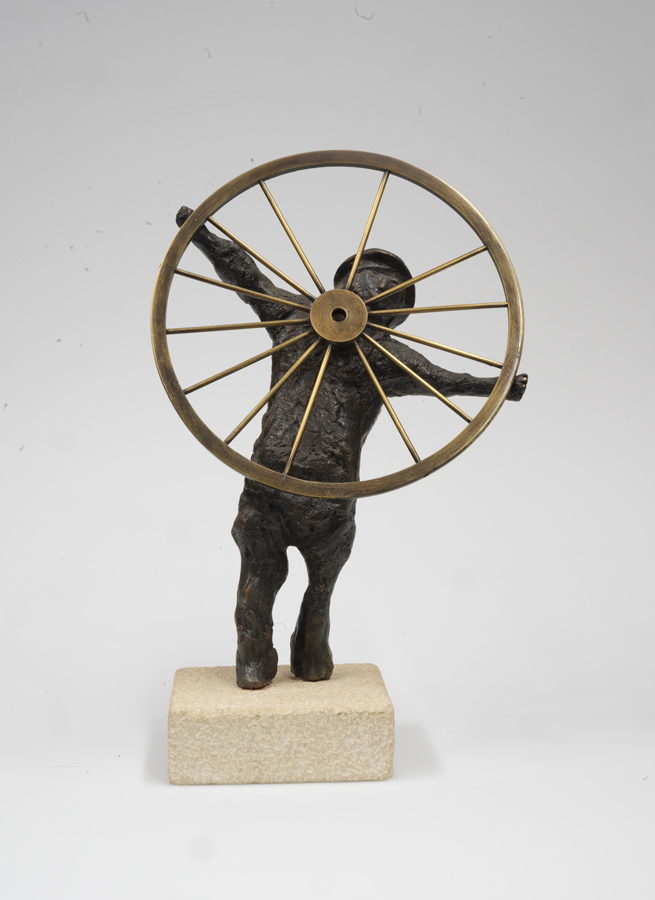
ESPIGA looks beyond nostalgia to recast rural life as a spare language of signs. Horses, wheels, carts and country women gave form to labour, movement, community and belonging.
Cosmic (1968-1979)
ESPIGA expanded rural signs into geometry, performance and public space. Against a background of war and ecological concerns, he considered humanity’s place within Earth and cosmos.
Luso-Geometric (1980-2014)
ESPIGA revisited earlier signs through geometry and his iconic Maps of Memory, connecting recurring symbols with his lived experience and the wider cultural memory of Portugal.
Image: Camponesa na Festividade, 2000. Acrylic on canvas. 162x100cm. Private collection.
ART BEYOND CATEGORY
ESPIGA’S Creation Across Media
ESPIGA moved freely across painting, drawing, sculpture, printmaking, performance, scenography, film, design and public art. Each medium offered a new form for ideas rooted in one connected visual language.
MUSEUM REPRESENTATION AND INSTITUTIONS
Collections & Representation
ESPIGA is represented in foremost museum and institutional collections in Portugal, including CAM – Centro de Arte Moderna Gulbenkian, the National Museum of Contemporary Art (MNAC) and the National Museum Soares dos Reis. Works are held in private collections internationally.
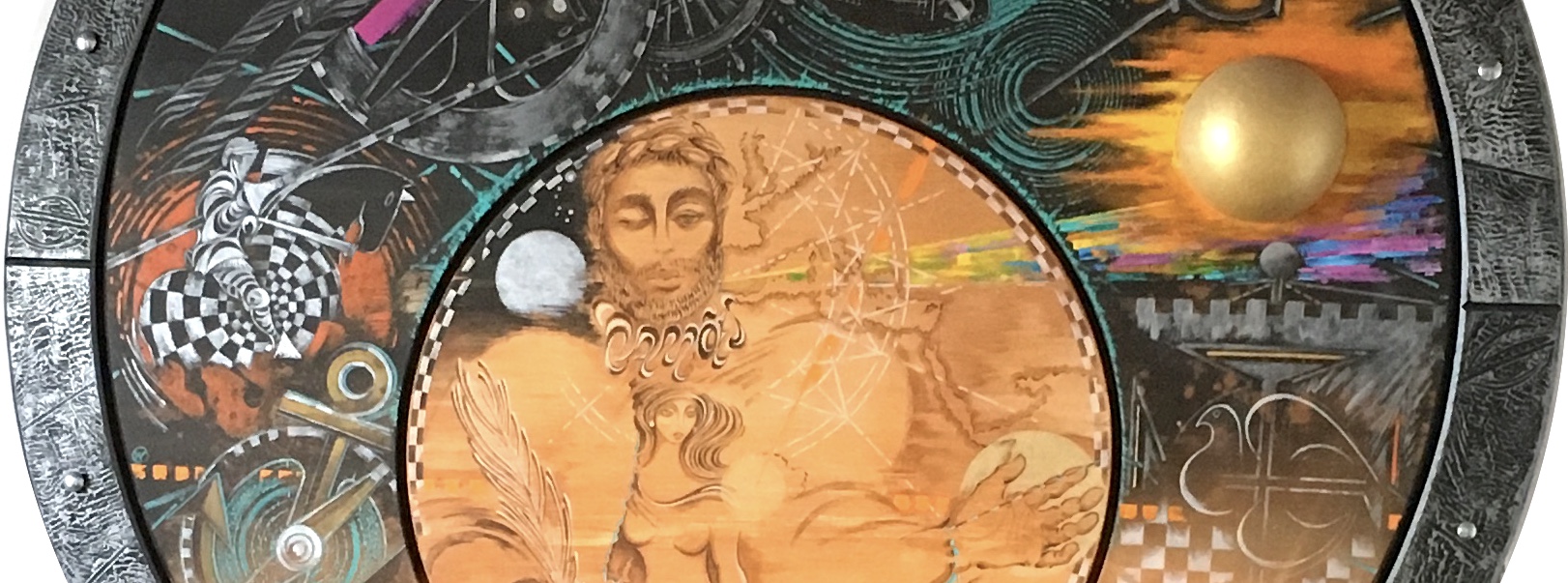
Untitled, 1964 (detail)
Vieux-chêne on cork mounted on paper.
49.9 x 37.5 cm
Collection: The MACAM Museum, Lisbon
In fact, while ‘modernity’ reveals a tendency towards the chaotic, the accidental, the arbitrary, the ‘raw’, perhaps even, the gratuitous, coexisting alongside it there is also the lineage of the organic, the systematic and the rigorous. And it is this lineage to which Espiga belongs.
David Mourão-Ferreira
Writer and poet
His greatness stems from the way in which he was able to avoid any documentarian detours and stay away from the temptations of the picturesque. It is for this reason alone that these artworks acquire an emblematic status…
Joaquim Matos Chaves
Art critic, professor at Porto School of Fine Arts
…it is fair to attribute to these performances by Espiga Pinto [in 1972, at Ponte da Arrábida and Casa da Carruagem, Valadares] a foundational role in the history of performance art in Portugal…
Helena Mendes Pereira
Curator and researcher
Combining the memories and affections he harbours from his native Alentejo, with the discoveries made by his incursion into geometry and cosmology, Espiga relentlessly seeks to integrate into imaginary spaces elements as diverse as those he recreates from the shapes and structures of rural tools, handmade ornaments and even anonymous stars.
Cecília Eiró
Art historian
Stay close to ESPIGA’s legacy.
Notes from the Archives
Discoveries, texts and research material on ESPIGA Pinto’s life and work.